
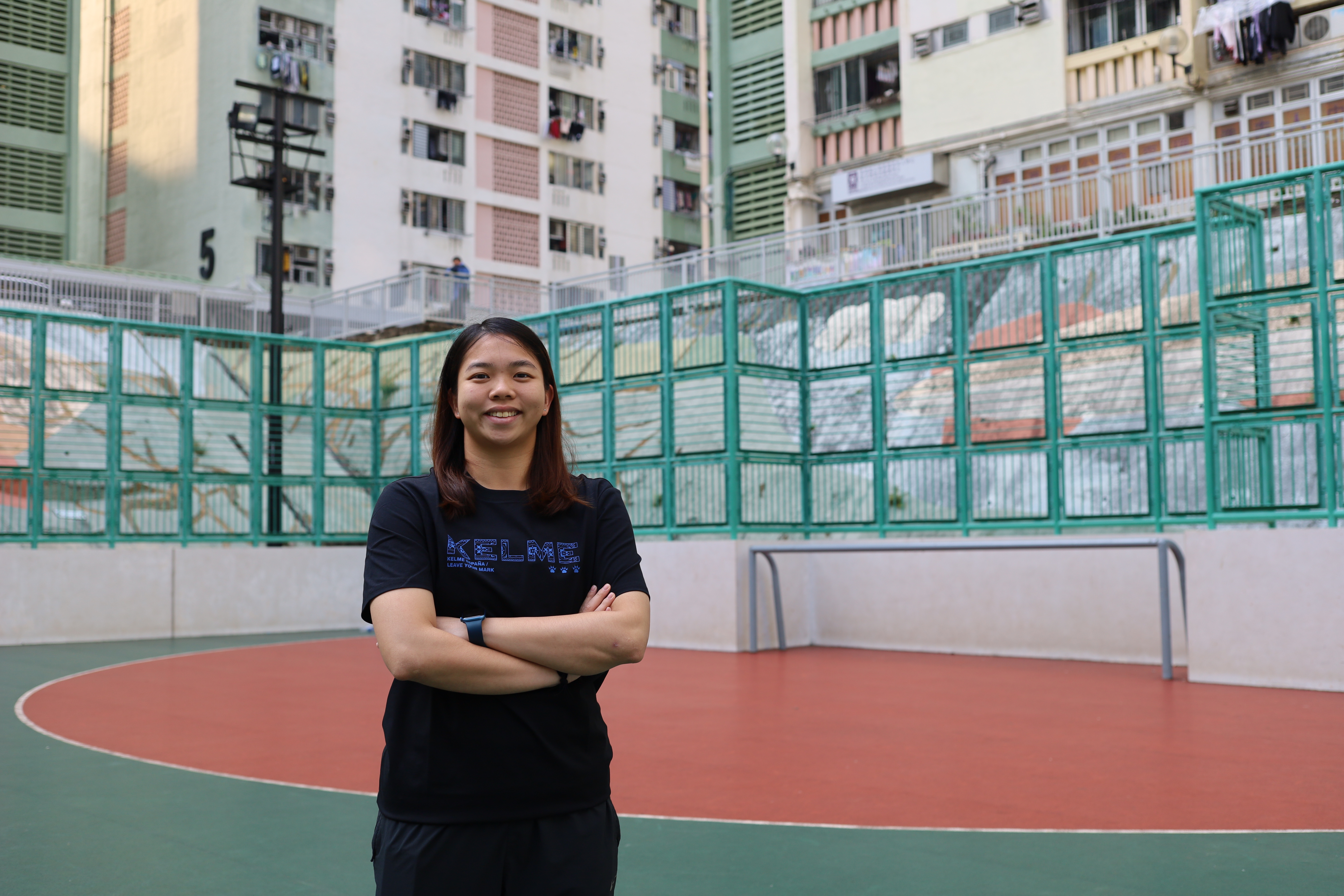
In recent years, there has been an increasing number of girls who have developed an interest in football. In Hong Kong, where women’s football has yet to fully professionalize, many players not only train and compete with their clubs or the national team but also engage in various roles within the football community. One such player is Kelly Chow, who was recently selected for the Hong Kong national team in the Turkish Cup. Like other players, she juggles part-time coaching responsibilities while also serving as a physiotherapy assistant for the Hong Kong Premier League’s Tai Po team. As team captain, she is also involved in administrative duties for WSE Women’s Team. Despite still being a student, this young goalkeeper dedicates her entire life to football, living it to the fullest every day.


Right:1st participation in the AFC U19 Championship Qualifiers representing the Hong Kong national team (provided by the interviewee).
From Tai Po to WSE
Kelly Chow, who initially focused on swimming, began her football career in high school during the summer before entering Form 4. Inspired by her senior, Chan Ching Man, who had been selected for the Hong Kong national team, their school decided to organize a girls’ football team in the new academic year. Kelly then enrolled in the Hong Kong Football Association’s summer training program. She continued her training and participated in competitions through regional programs and the Citizen Youth Team. Initially playing as a forward, she had a moment during a five-a-side match where she volunteered to play as a goalkeeper to allow her teammate to have a chance to play. After making a crucial save against a representative of the Hong Kong team, she discovered a greater sense of fulfillment than scoring a goal, leading her to pursue a career as a goalkeeper.
During her youth years, Kelly played for various teams, including the regional, Citizens, and HKRT. However, there was a period of over a year when she stopped playing football due to uncertainties about her future and concerns about the intense competition in adult teams. She even switched to playing basketball for a while. It was at a match between Wofoo Tai Po and her friend’s team that she ran into the youth team coach, Ms. Lee, who mentioned upcoming selections for the national team. Encouraged by her friend, Kelly approached Wofoo Tai Po and inquired about the possibility of joining the team, especially since they needed a goalkeeper following the departure of a previous player.
In her first two years with Wofoo Tai Po, Kelly was not the first-choice goalkeeper. However, she gradually became a key player starting from last year. This year, after Wofoo Tai Po transitioned to Wofoo Social Enterprises (WSE), she took on the role of team captain and led the team in the Women’s Premier League. Although both Wofoo Tai Po and WSE are not considered top-tier teams in the league, Kelly believes that being a goalkeeper and playing for mid-table teams has allowed her to learn more and gain ample playing opportunities. The team focuses on encouragement and guidance, and in the past, Coach Ye (Ye Jia) emphasized the importance of enjoying the game since they are not professional players. However, with the arrival of the new coaching staff this season, led by Coach Ye taking a step back and emphasizing communication with the players, there is more collaboration in discussing tactics and strategies together.
Around-the-clock
Kelly is studying for a Bachelor’s degree in Sports and Recreation Management at Baptist University, like many male and female players, has to balance her studies with training and competitions. In the previous season, she started an internship at a physiotherapy clinic, which happened to serve the Hong Kong Premier League’s Tai Po team. As a result, she began working as an assistant to the physiotherapist, allowing her to get involved in the day-to-day operations of a professional football team for the first time. “Last season, I was also a player for Tai Po, so I mustered up the courage to ask if I could train with the men’s team. The goalkeeper coach at the time, Chan Ka Kei, agreed. Later, with Chan’s emigration, most of the training responsibilities were taken over by Lee Hon Ho. Sometimes, when the players see me, they ask if I can give them a massage before or after training, but Lee Hon Ho would step in and tell everyone that today I’m here as a player and should focus on that.”
“Lee Hon Ho didn’t intentionally arrange any additional or reduced training difficulties for me. Basically, I followed the regular pace of the men’s team during training. Of course, the men’s players shoot the ball much faster, and sometimes the foreign players would say sorry after shooting, but they don’t hold back because I’m a female goalkeeper. Sometimes, they even compliment me when I save their shots. Compared to Hong Kong women’s matches, where players generally rely more on tricky angles or stopping one-on-one situations, the men’s game requires more agility and footwork.”


Mid/Right:Kelly works as a physiotherapy assistant for the Tai Po men’s team in the Hong Kong Premier League, providing support during player training and matches (nk17).
Kelly, who is currently in her final semester, has a very busy schedule. She strategically scheduled her classes to have more days off, allowing her to do morning gym workouts, focus on homework or play matches with Tai Po in the afternoon, and train or play matches with her club or the Hong Kong team in the evening. Sometimes, she even teaches football on weekend mornings. A few months ago, she was even continuing to work at a clinic and bringing her homework there to do. “When I graduated from secondary school, I had thought about not pursuing further education. It was at the request of my family that I continued my studies. By Year 2 or 3, I started to feel that studying was not a bad thing after all. After all, it provides a guarantee for my future life, and I have also met many friends from different fields. Football has given me so much, including the opportunity to represent Hong Kong and see the world. However, an athlete’s career is short, and after entering society, I will have less and less time to play football. So at this moment, after graduation, I hope to temporarily not join the education sector and strive for opportunities outside, even if it means trying something completely different. I want to go out and see for myself how I compare to the outside world.”
Kelly and HKRT goalkeeper Ng Cheuk Wai (Mi) have known each other since they were young, and she greatly admires Mi’s determination to venture outside of Hong Kong. She also sees Mi as a role model and often learns from her experiences playing in Taiwan and Japan. “Even before going abroad to play, when I was coaching a group of primary school students for an exchange in Japan, I could already feel the differences between Hong Kong and other places. You would observe that local male and female players train together until junior high school and then separate in high school. However, in Hong Kong, boys and girls may already be separated as early as under 10. Is there really a need for this? Would it be helpful for the development of women’s football if we waited until under 13 to separate the training? Of course, this is also influenced by the social situation in Hong Kong, but even the coaching style, commitment, and attention to detail are very different from Hong Kong. You can clearly see these differences.”
Environment
Although Kelly’s life is already almost 100% focused on football, she hopes to fully devote herself and become a 100% football player. “The women’s football environment in Hong Kong has improved slightly compared to before. We now have a three-tier league, but the overall quality of the pitches is not great. Places like Po Tsui Park are completely deteriorated. Is it safe for us to participate in matches there as national team members? We have experienced situations where we were scheduled to play at Tsang Tai Uk, with the game starting at 7 pm, but the Leisure and Cultural Services Department told us we couldn’t enter for warm-up at 6:30 pm because the venue supervisor from the Hong Kong Football Association hadn’t signed off yet. So we had to warm up on a basketball court and were later kicked out by the department. These conditions are far from ideal.”
“Also, many players, including myself, are still university students. In this season, many university matches start at 4 pm, and sometimes we finish at Pak Shek Kok around 6 pm. However, league matches and the FA Cup sometimes start at 7 pm in Tsing Yi or at the Football Training Centre. There was one time when we rushed from the car park to the pitch, and the referee was already checking our jersey numbers. Of course, we have heard of players not making it in time for kick-off. This situation puts both the clubs and the university team coaches in a difficult position. In general, the training and match venues for women’s football are quite remote, and the commuting time is longer than the actual practice time. These factors contribute to my desire to go out and try to live in an environment that allows me to focus solely on football.”


Right:Currently serving as the captain of Happy Valley Social Enterprise team (provided by the interviewee, @hk_12th).
Profile
| Name | 周錦儀 Kelly Chow |
| Pos. | GK |
| Preffered foot | 右腳 |
| Birth | 1999/11/11 |
| Adult team | Citizens(2015-17) WF Tai Po(2019-23) Wofoo Social Enterprises(2023-) |