
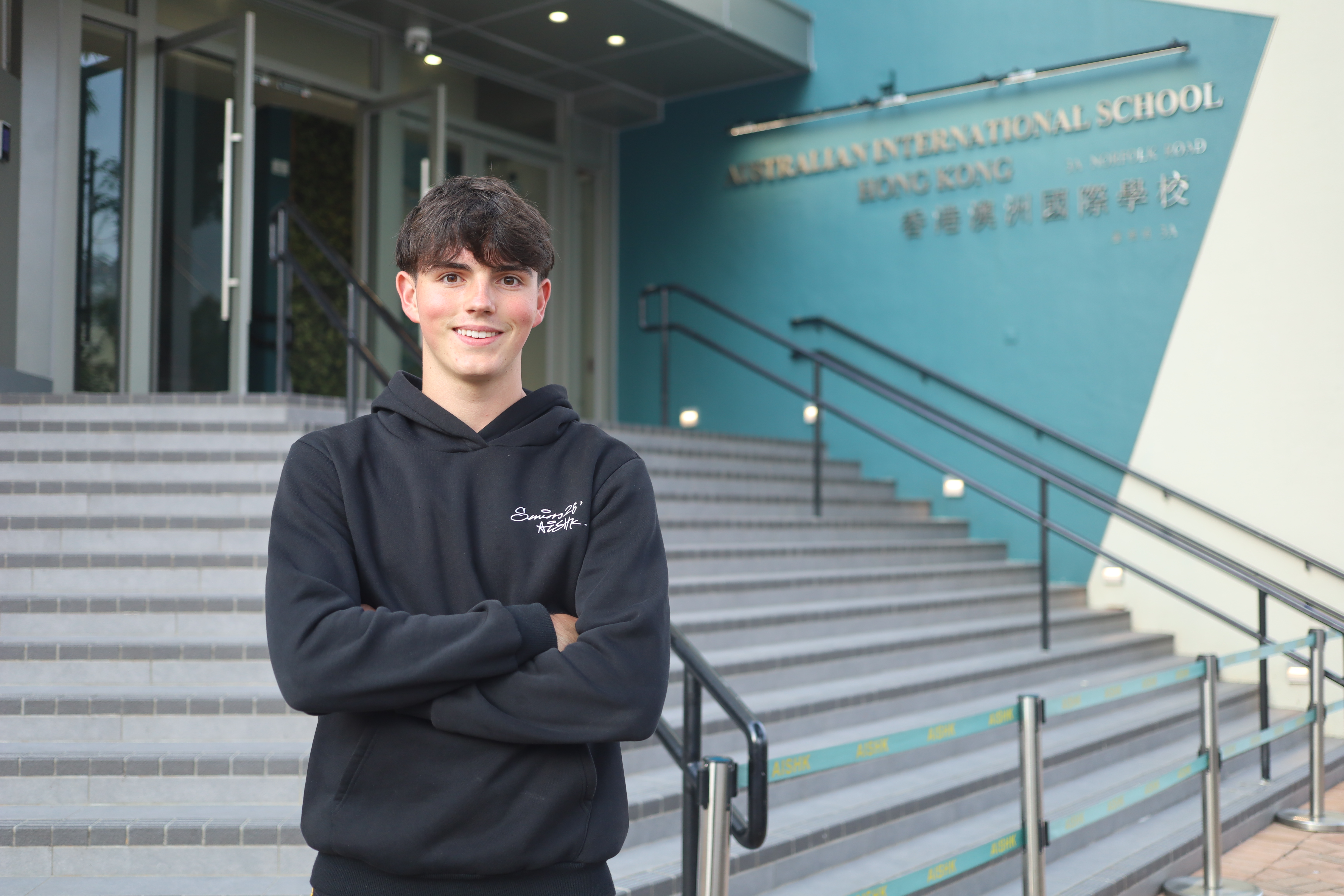
While the Hong Kong Football Club (HKFC) built their squad around a core of young talent this season, they ultimately found themselves bottom of the table. However, several of their rising prospects have successfully caught the eyes of local fans. Among them is forward Cai McGunnigle.
Midway through the season, Cai’s impressive performances earned him a call-up to the Scotland U17 national team by the Scottish FA, where he went on to feature in the UEFA European Under-17 Championship qualifiers. After overcoming an injury setback, he has increasingly established himself as a focal point in HKFC’s attack.
Between late April and May, he registered crucial goals or assists in three consecutive league matches, successfully helping HKFC secure double-digit points for the season. At just 17 years old, this young starlet has emerged as one of the most exciting prospects in local football this season, driven by a clear and ultimate ambition: to play for the senior Scotland national team.
Born in Hong Kong, Cai’s parents hail from Glasgow, Scotland, and relocated to the city 22 years ago for work.
“I started playing for the Hong Kong youth levels around age five or six. But at that age, I also played tennis. I used to have training sessions for both, but after a stage, I just preferred football.’
He joined the youth academy at Kowloon Cricket Club (KCC) at the U7 level, remaining loyal to the club until 2019. He then joined APSS, and later transferred to KC Southern to participate in the U14 Super Youth League. He then joined the HKFC youth team.
Every year during the Christmas and New Year holidays, he would return to Scotland with his family, during which he also spent time sharpening his skills at youth training camps hosted by Scottish Premiership side St. Mirren FC.
I left kcc in 2019 to APSS before leaving to KC southern u14 ypl for a season before moving too HKFC youth system


From HKFC to Scotland
Cai was promoted to the HKFC first team for the 2024–25 season. In the final match of the campaign against Kowloon City, he found the back of the net, becoming the youngest goalscorer in Hong Kong Premier League history at just 16 years and 1 month old. Following this milestone, he was selected for the Premier Youth League Select XI to face the Manchester United U16s in an exhibition match in August.
He put on a masterclass, netting two goals and rightly earning the Man of the Match award. This stellar performance caught the attention of Scotland youth national team. After the match, James Grady of the Scottish Football Association contacted McGinnig via email, informing him that national team coach Brian McLaughlin had called him up for the U17 national team.
The young starlet soon jetted off to Portugal in September for a nine-day training camp, featuring in an international friendly tournament against powerhouse nations Serbia, Portugal, and Italy. By October, he was selected again for the first round of the UEFA European Under-17 Championship qualifiers, spending two weeks with the squad and playing 45 minutes against Sweden.
Unfortunately, a severe illness sustained during the tournament sidelined him for four months, ruling him out of the second-round qualifiers in March this year. Scotland ultimately finished second in their group during that round, narrowly missing out on the final tournament.
Despite the injury setback, these two call-ups proved to be a massive eye-opener for McGunnigle. Beyond the opportunity to test himself against elite European youth talent, he was profoundly impressed by the sheer professionalism within the Scotland setup.
“For the national team, it’s super professional. Everyone around you is amazing,” he reflected. “The staff looks after all the details. Training is high-paced. It’s not just walking around; it’s about being aware of everything. After lunch, you have a second session. It’s a lot more intense.”
“Take the day before a match, for example. You wake up, have breakfast, and they have hydration tests to see how you’ve recovered. They are very strict on the diet. They control everything you eat.”
While a player from the Hong Kong Premier League breaking into a European national youth team might sound far-fetched to some, Cai believes his experience gives him a unique edge. “In Scotland, the U17 players are technically very sharp, but in terms of physical confrontation, I’d say the intensity is completely different for a youngster playing senior football. I am already playing competitive, professional matches in the HKPL, where the foreign players are physically dominant and technically gifted. So, when I went back to train and play with the national team, that senior experience was incredibly valuable.”


Forged in the HKPL: Developing the Physical Edge
“In other big football nations like Scotland and other places… after a training session, people do the extra work. You cannot do that on the same pitch in Hong Kong because people need the pitch to play on. That’s a big difference in Hong Kong.”
Even so, Cai’s international call-up serves as a massive inspiration to young footballers across Hong Kong. It proves that with exceptional performances, players developing their game right here in Hong Kong can still capture the attention of the European football world.
“I think young players now could go and train and play in Hong Kong… they have the skill, they have the talent… back in Scotland it’s high standards… Hong Kong has started to progress, although it’s slower than other places.”
While his family have always been lifelong Celtic supporters, McGunnigle actually had a trial stint with their fierce rivals, Rangers FC. Now, with international youth experience under his belt, his mind is firmly made up. He has set his sights on establishing himself in European football and fulfilling a ultimate dream: representing Scotland on the grandest stages of all—the UEFA European Championship and the FIFA World Cup.
“I want to play in the Champions League, I want to play at the top level… that is my aspiration. So when the time is right… every summer I go to do some trials.”
“Now I’m not sure, but I’m going… I’m not sure, my agent is handling it… we have to wait and see. They tell me there’s interest abroad in europe…to try and get some opportunities. But I can’t just wait on a contract, I will keep studying, training and playing even if I get a contract. To have the chance at a professional contract abroad I have to be in the right frame of mind and at the peak of my game physically and mentally.”

Editor’s Note: How Does a Player Participate in a Trial?
Article 19 of the current FIFA Regulations on the Status and Transfer of Players (RSTP) sets out explicit rules regarding trials for academy players. The objective is to protect minors, ensuring they are not constantly shuttled between different clubs to the detriment of their education and physical or mental well-being.
A minor player (under the age of 18) is permitted a maximum of two trials per calendar year. Furthermore, the cumulative trial period at a single club must not exceed eight weeks per season (which can be consecutive or non-consecutive). Generally, a player must be in the season of their 16th birthday to eligible for a trial; however, if both the player and the club are based within Europe, this age threshold is lowered to 15.
Under RSTP Article 19, before a player can participate in a trial, the inviting club must first issue an Official Invitation Letter. This document must specify the dates, duration, accommodation arrangements, and insurance coverage of the trial. Additionally, if the player is currently under contract or registered as an academy player with another club, the trialing club must notify the current club in writing.
Within 10 days of the start of each trial, the club is required to complete the FIFA Trial Form. This form must be co-signed by the player, the club, and the player’s parents or legal guardians (if the player is a minor), confirming that the number of trials undertaken in that year has not exceeded the permitted limit. Once completed, the form must be uploaded to the FIFA Transfer Matching System (TMS).
Any undeclared trials will be deemed a regulatory breach, leaving both the club and the player liable to disciplinary sanctions. Furthermore, the club must ensure that the player holds adequate medical insurance during the trial period; should the player sustain an injury during the trial, the liability for medical expenses and compensation rests entirely with the trialing club.
Profile
| 姓名 | 麥根尼高 Cai Gabriel McGunnigle |
| 位置 | CF |
| 擅長腳 | 右腳 |
| 出生日期 | 2009/3/30 |
| 職業球隊 | 港會(2024-) |
未成年人政策
本篇文章刊登時受訪者尚未年滿18歲,OneTwo.hk在訪問前已先取得受訪者本人及其法定監護人同意,而在刊登前亦已獲受訪者本人及監護人確認內容。
OneTwo.hk在刊載未成年人專訪時,會確保訪談及刊登內容在受訪者及監護人知情及同意下進行,以保障未成年受訪者之私隱及權益。如有任何查詢,歡迎電郵至onetwo@onetwohk.net聯絡我們。